


How to Choose Food Safe Wipes for Kitchen Surfaces
Bernard ColganLast Updated: November 9, 2026
Quick Summary
To choose food safe wipes for kitchen surfaces, check the wipe is certified for food contact surfaces, read the formula, match it to the surface and the job, confirm whether it needs a rinse, and compare the cost per wipe, not per pack. If the label does not say food contact surfaces, do not use it on prep areas.
- Certified for food contact surfaces, not just "antibacterial".
- Alcohol-free and fragrance-free formulas suit food areas best.
- Use a wipe listed for probes on temperature probes.
- Rinse-free saves a step, but follow the contact time on the label.
- Work out the cost per wipe: Pal TX is about 2.1c a wipe + VAT.
Table of Contents
- What Makes a Wipe Food Safe?
- Step 1: Is It Certified for Food Contact Surfaces?
- Step 2: What Is in the Formula?
- Step 3: Does It Suit the Surface and the Job?
- Step 4: Does It Need a Rinse?
- Step 5: Are You Cleaning or Disinfecting?
- Step 6: What Does It Cost Per Wipe?
- How Should You Use Probe Wipes?
- Ordering From DiscountTillRolls.ie
- Frequently Asked Questions
What Makes a Wipe Food Safe?
A food safe wipe is one whose label and technical data say it is suitable for surfaces that touch food, used as directed, without leaving harmful residue. "Antibacterial" on the tub is not the same thing. Plenty of antibacterial wipes are made for general surfaces, not prep tables, chopping boards or probes.
The six checks below take a few minutes and save you buying the wrong case.
Step 1: Is It Certified for Food Contact Surfaces?
Check the certification, and check what it covers. A certificate for general hard surfaces does not automatically cover food contact surfaces. Ask the supplier for the safety data sheet and technical sheet, and keep them on file with your HACCP records so an inspector can see what you use and why.
- Named certification: look for the certificate itself, not a vague claim on the pack.
- Scope: it should name food contact surfaces.
- HACCP fit: the wipe's contact time and rinse instructions should match what your cleaning plan says you do.
The FSAI Safe Catering pack shows how cleaning fits into your food safety system, and the European Commission sets out the rules on food contact materials.
Step 2: What Is in the Formula?
Read the formula before you buy. For food areas, the safest picks are alcohol-free and fragrance-free, with a clear statement that they are suitable for food contact surfaces.
- Alcohol-free: no flammability near heat and less risk of tainting surfaces.
- PHMB-free and QUAT-free: worth checking if your site restricts these chemicals.
- No fragrance: scent has no place on a prep table.
The Pal TX Surface & Probe Disinfectant Wipes are alcohol-free, PHMB-free and QUAT-free, PSC certified and food safe, and need no rinse. They are listed for food contact surfaces and temperature probes.

Step 3: Does It Suit the Surface and the Job?
Match the wipe to the material and the task, not just the room. A disinfectant wipe that is fine on stainless steel is not automatically right for a wooden board, and a cloth for spills is not a disinfectant.
Surface or job |
What to use |
Watch out for |
|---|---|---|
Stainless steel and laminate prep tables |
Food safe disinfectant wipe |
Wiping dry before the contact time is up |
Wooden chopping boards |
Only a product whose label names wood |
Residue soaking into the grain |
Temperature probes |
A wipe listed for probe use |
General surface wipes not made for probes |
Spills and general wiping |
Food safe cloths, colour-coded by zone |
Using a cloth where a disinfect step is needed |
For spills and wiping down, Envirolite folded cloths come in blue, green, red and yellow, and Envirowipe Plus cloths are the heavier-duty option in green and blue. Both are certified food safe. Our colour-coded cleaning cloths guide covers which colour goes where.
Step 4: Does It Need a Rinse?
It depends on the product, so check the label. Rinse-free wipes save time on a busy line, but you still need to leave the surface wet for the contact time stated before it is used again. If a product needs a rinse, build that step into your cleaning routine and your records, or it will get skipped.
Step 5: Are You Cleaning or Disinfecting?
Cleaning removes dirt and food. Disinfecting kills germs on a surface that is already clean. A disinfectant wipe on a greasy, dirty surface will not do its job properly, so clean first, then disinfect, then leave it for the contact time.
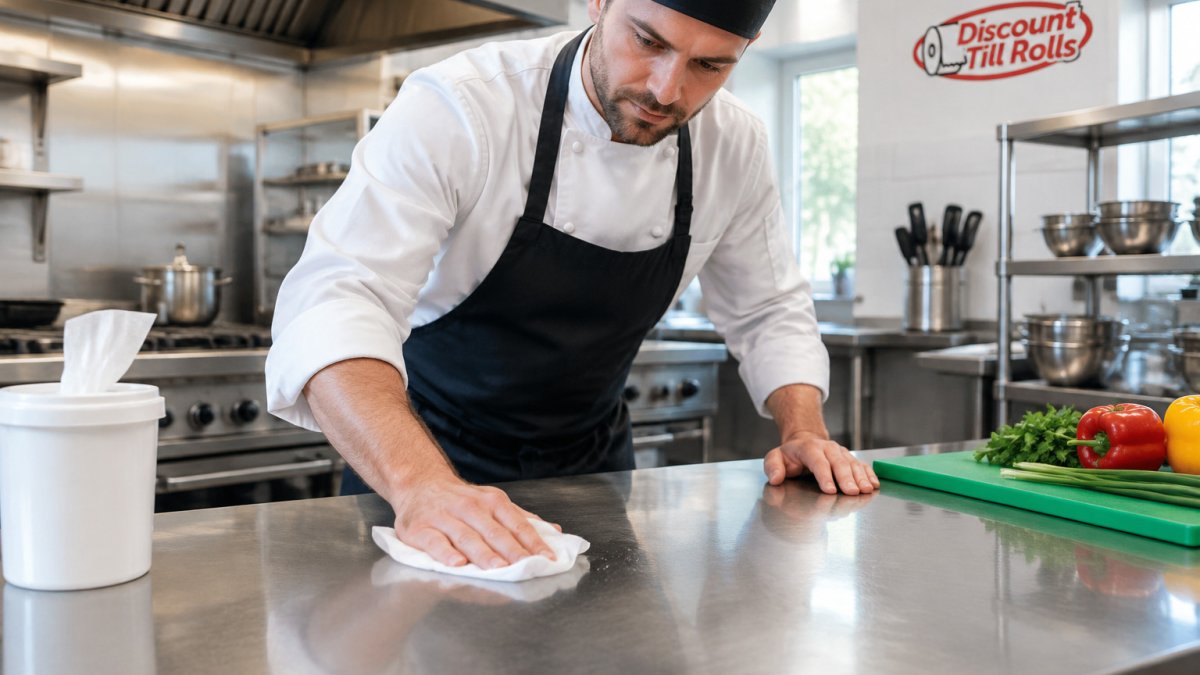
For dilution, contact time and which chemical does what, see our commercial kitchen cleaning chemicals guide.
Step 6: What Does It Cost Per Wipe?
Compare the price per wipe or cloth, not per pack. Divide the case price by the number in the case, then think about how many you use on a typical day.
Product |
Case |
Price + VAT |
Per wipe or cloth |
|---|---|---|---|
10 x 200 (2,000) |
€41.95 |
About 2.1c |
|
10 x 50 (500) |
€44.95 |
About 9c |
|
6 x 25 (150) |
€50.99 |
About 34c |

If any of your staff react to certain chemicals or scents, alcohol-free and fragrance-free options are the kinder choice.
How Should You Use Probe Wipes?
Wipe the probe after every reading, not just at the end of the shift. A probe goes into raw and cooked food, so a quick wipe stops it carrying anything from one to the other. Keep a tub of probe wipes at the probe station, not in the store cupboard, so the step never gets skipped. Never put a probe back in a drawer with food still on it.
Ordering From DiscountTillRolls.ie
DiscountTillRolls.ie has supplied Irish food businesses since 2007 from Unit 4, Naas Road Ind. Park, Dublin 12. Order before 1pm Monday to Friday and it is shipped at 2pm the same day, or call and collect from Dublin 12.
Not sure which wipe suits your kitchen? Ring us on 01 443 3964 or email Sales@discounttillrolls.ie. Browse the full cleaning and hygiene range.
Frequently Asked Questions
What makes a wipe food safe?
A wipe is food safe when its label and technical data say it is suitable for food contact surfaces, used as directed, without leaving harmful residue. Antibacterial on its own does not mean food safe. Check the certification covers food contact surfaces, and keep the safety data sheet on file with your HACCP records.
Are all antibacterial wipes suitable for food prep surfaces?
No. Many antibacterial wipes are made for general surfaces and can leave residue, contain fragrance or need a rinse a busy kitchen will skip. Only use a wipe on prep areas if the label says it is suitable for food contact surfaces. If it does not say so, treat it as unsuitable until the supplier confirms in writing.
Do I need to rinse after using food safe wipes?
It depends on the product, so follow the label. Pal TX Surface & Probe Disinfectant Wipes need no rinse. Others need a drinking water rinse before food goes back on the surface. Either way, leave the surface wet for the contact time stated, and record the step in your cleaning log.
How often should you wipe a temperature probe?
After every reading. A probe goes into raw and cooked food, so wiping it between uses stops it carrying contamination from one to the other. Use a wipe listed for probes, keep a tub at the probe station rather than in a cupboard, and never put a probe away with food still on it.
How much do food safe wipes cost per wipe?
Divide the case price by the number in the case. Pal TX wipes are €41.95 + VAT for 2,000, about 2.1c a wipe. Envirolite folded cloths are €44.95 + VAT for 500, about 9c each, and Envirowipe Plus cloths are €50.99 + VAT for 150, about 34c each. Order before 1pm and it is shipped at 2pm.
