


How to Organise Commercial Kitchen Food Storage
Bernard ColganLast Updated: November 9, 2026
Quick Summary
To organise commercial kitchen food storage, put ready-to-eat and cooked food on the top shelves of the fridge and raw meat, fish and poultry covered on the bottom, with raw poultry lowest. Date everything as it goes in, put new deliveries behind older stock, and keep bags, film and labels at the station so the system holds on a busy night.
- Ready-to-eat on top, raw at the bottom, everything covered or sealed.
- New stock goes behind old stock, every delivery, every time.
- Nothing goes into the fridge or freezer without a date and a description.
- Keep two bag sizes, two film widths and a label roll at the prep station.
- Count storage supplies weekly and reorder before you hit your minimum.
Table of Contents
- What Is the Right Order for a Commercial Fridge?
- How Do You Keep FIFO Working During a Busy Service?
- What Should a Food Storage Label Say?
- How Should You Organise the Freezer and Dry Store?
- Which Storage Supplies Should a Kitchen Keep in Stock?
- How Do You Stop Running Out of Storage Supplies?
- Where Do Cleaning and Hygiene Fit In?
- Ordering From DiscountTillRolls.ie
- Frequently Asked Questions
What Is the Right Order for a Commercial Fridge?
Ready-to-eat and cooked food goes on the top shelves. Raw meat, fish and poultry go underneath, covered or sealed, with raw poultry on the lowest shelf. The reason is simple: drips travel down. Nothing raw should ever sit above food that will be served without further cooking.
Shelf Order From Top to Bottom
Shelf |
What goes there |
Why |
|---|---|---|
Top |
Ready-to-eat food, cooked food, desserts, deli items |
Nothing above it can drip on it |
Middle |
Dairy, prepped veg, sauces and part-prepped items |
Clean items kept above raw |
Lower |
Raw fish and whole cuts of raw meat, covered |
Below everything ready to eat |
Bottom |
Raw minced meat and raw poultry, sealed or in trays |
Highest drip risk, lowest shelf |
Keep food covered or sealed, never sitting straight on the shelf, and leave space so cold air can move. Check and record fridge temperatures against the limits in your own HACCP plan. The Food Safety Authority of Ireland is the place to check if you are unsure.
Where Bags and Containers Fit In
Portioning is where most fridges lose their order. A sealed bag stops drips and stacks flat, and a bag with a printed label saves a step at the busiest point of prep.
The Hero Double Seal Food & Freezer Bags 1L have a double zip seal and a fill-in label printed on the bag for description, use-by date, allergens and storage instructions. A case of 420 bags is €27.99 + VAT, about 6.7c a bag. For whole cuts and batch portions, the Hero 3.8L bags come 360 to a case at €35.99 + VAT, about 10c a bag. Both are freezer safe. See the full food and freezer bags range.


How Do You Keep FIFO Working During a Busy Service?
FIFO (first in, first out) only works if the oldest item is the one staff see first. So the layout has to do the work, not memory. New deliveries go behind existing stock, never in front, and older items get pulled forward at the start of each shift.
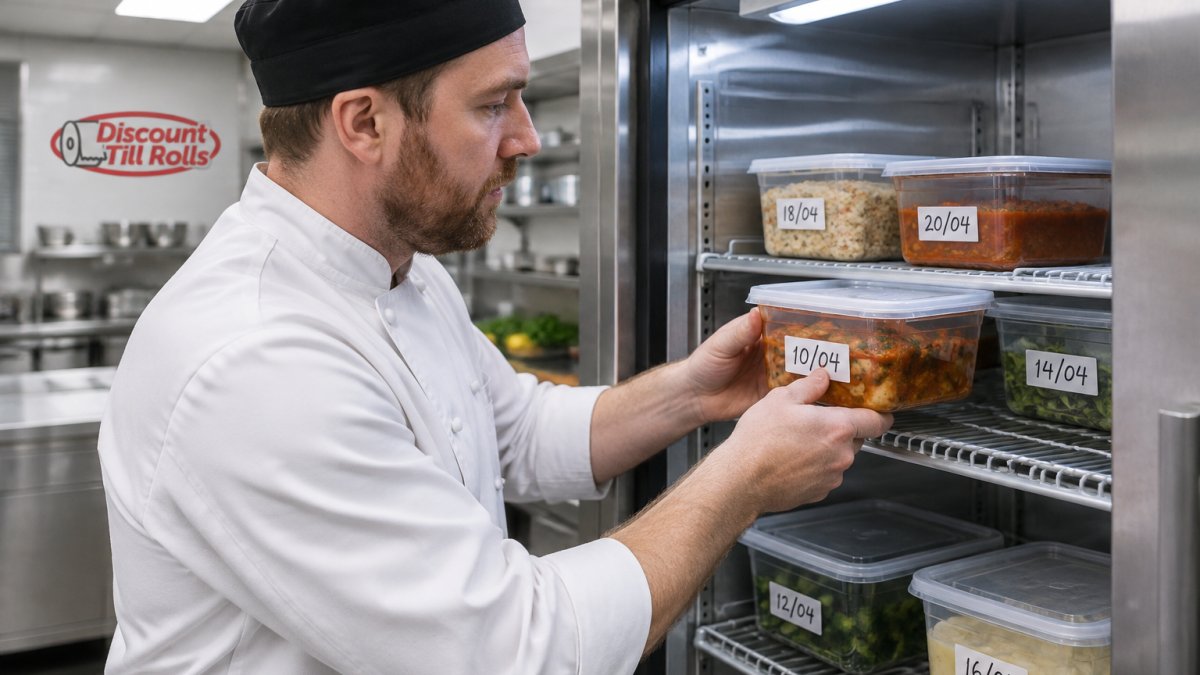
- Date every item as it goes in, not at the end of prep.
- Unload deliveries to the back of the shelf, then pull older stock forward.
- Do a quick front-of-shelf check at the start of every shift and use or bin anything at its date.
The usual way FIFO breaks is a delivery stacked on the front of the shelf during a rush. Staff grab the nearest item, and the older stock goes out of date at the back. For how to set shelf life rules and run a rotation system, see our day dots and food rotation labels guide.
What Should a Food Storage Label Say?
A food storage label should give the product name, the date it was made or opened, the use-by date, allergens where they apply, and the initials of whoever prepped it. If it is not labelled, nobody knows how old it is, and it ends up in the bin.
Label |
Size and roll |
Price + VAT |
Best for |
|---|---|---|---|
39x48mm, 620 per roll |
€5.99 a roll (min. 2 rolls), about 1c a label |
Deli tubs, best-before and allergen labels |
|
52x29mm, 1,000 per roll |
€6.75 a roll (min. 2 rolls), under 1c a label |
High-volume prep labelling |
|
60mm continuous |
€9.50 a roll |
Delis weighing and pricing food |
Both Brother labels fit Brother QL printers and need no ink. The full range is in our Brother DK labels collection, and the 14 allergens guide covers what customers need to see.
How Should You Organise the Freezer and Dry Store?
Treat the freezer and dry store the same way as the fridge: everything sealed, dated and in a fixed place, with the oldest at the front. Fixed places matter more than people think. If the bags, wraps and containers always live in the same spot, staff stop improvising when they are busy.
- Freezer: freeze in flat, sealed bags so portions stack and thaw evenly. Write the date and contents before the bag goes in, not after it has frosted over.
- Dry store: keep food off the floor, open packs sealed or decanted into lidded, labelled containers, and new stock behind old.
- Packaging and chemicals: store disposables away from food and keep cleaning chemicals in their own labelled area, never above food or packaging.
Which Storage Supplies Should a Kitchen Keep in Stock?
Most kitchens need two bag sizes, two widths of cling film and a label roll at every prep station. That covers portions, whole cuts, bowls and full gastronorm trays without anyone doubling up narrow film on a wide tray.
Item |
Pack |
Price + VAT |
Works out at |
|---|---|---|---|
420 bags |
€27.99 |
About 6.7c a bag |
|
360 bags |
€35.99 |
About 10c a bag |
|
6 x 300m rolls |
€35.99 |
€6.00 a roll |
|
6 x 300m rolls |
€46.20 |
€7.70 a roll |
|
620 labels a roll |
€5.99 a roll |
About 1c a label |

Use the 30cm film for bowls and portions and the 45cm film for gastronorm pans and big trays. Our cling film, foil and parchment guide covers widths and dispensers, and the film, foil and parchment collection has the full range.
How Do You Stop Running Out of Storage Supplies?
Set a minimum for each storage line, count weekly, and reorder anything below its minimum before the weekend. Set the minimum from what you actually used last month, not a guess, and review it when the menu or the season changes.
- List your storage lines: bags (both sizes), cling film (both widths), labels, lidded containers.
- Write a minimum next to each, based on last month's use.
- Count on the same day each week, including the store room, not just what is on the station.
- Anything below its minimum goes on that day's order.
Counting only the station and ignoring the store room is how a kitchen ends up with three boxes of bags it cannot find and none where they are needed.
Where Do Cleaning and Hygiene Fit In?
Clean storage needs clean shelves, containers and hands, but cleaning has its own guides so we will not repeat them here. For sanitiser dilution, contact time and chemical storage, see our commercial kitchen cleaning chemicals guide. For which cloth colour goes where, see colour-coded cleaning cloths. Supplies are in our cleaning and hygiene range.
This is practical guidance, not legal advice. Your own HACCP plan and the FSAI set the rules for your business.
Ordering From DiscountTillRolls.ie
DiscountTillRolls.ie has supplied Irish food businesses since 2007 from Unit 4, Naas Road Ind. Park, Dublin 12. Order before 1pm Monday to Friday and it is shipped at 2pm the same day. Local? Call and collect from Dublin 12.
Not sure which bag, film or label suits your kitchen? Ring us on 01 443 3964 or email Sales@discounttillrolls.ie and talk to a real person. Or browse the full catering supplies range.
Frequently Asked Questions
What order should food go in a commercial fridge?
Ready-to-eat and cooked food goes on the top shelves, with dairy, prepped veg and sauces below. Raw fish and whole cuts of raw meat go lower, covered, and raw minced meat and raw poultry go on the bottom shelf, sealed or in trays. Drips travel down, so nothing raw should ever sit above food that will not be cooked again.
Where should new deliveries go on the shelf?
Behind the existing stock, every time. That is FIFO, first in, first out: the oldest item sits at the front so it is used first. Unload the delivery to the back, pull older stock forward, and do a quick front-of-shelf check at the start of each shift to use or bin anything at its date.
What should a food storage label include?
The product name, the date it was made or opened, the use-by date, any allergens and the initials of whoever prepped it. Label it before it goes into the fridge or freezer, not after. Printed labels such as Brother DK-11220 compatible food labels (39x48mm, 620 a roll, €5.99 + VAT) save time on a busy prep.
What size food bags does a commercial kitchen need?
Most kitchens keep two sizes: a 1L bag for portions and prepped ingredients, and a larger bag for whole cuts and batch storage. Hero Double Seal bags come in 1L (420 a case, €27.99 + VAT) and 3.8L (360 a case, €35.99 + VAT), both freezer safe with a fill-in label printed on the bag.
How do you stop a kitchen running out of storage supplies?
Set a minimum for each line (bags, cling film, labels, containers) based on last month's use. Count on the same day every week, including the store room, and reorder anything below its minimum before the weekend. With DiscountTillRolls.ie, order before 1pm Monday to Friday and it is shipped at 2pm the same day.
