


Save Money on Restaurant Paper Supplies: 7 Proven Ways
Editorial TeamTable of Contents
- Why Paper Supply Costs Creep Up on Busy Kitchens
- Step 1: Audit What You Actually Use Each Week
- Step 2: Buy Bulk Catering Disposables in Ireland the Smart Way
- Step 3: Switch to Wholesale Thermal Till Rolls for Your POS
- Step 4: Cut Paper Waste in Hospitality Without Cutting Corners
- Step 5: Negotiate Better Terms With Your Supplier
- Step 6: Choose Eco-Friendly Swaps That Don't Cost More
- Step 7: Build a Replenishment System That Prevents Panic Orders
- Frequently Asked Questions
Last Updated: September 15, 2026
Why Paper Supply Costs Creep Up on Busy Kitchens
Restaurant paper supplies are the quiet line item that balloons without anyone noticing. Nobody signs off on spending more on napkins, till rolls, and takeaway containers; the cost just drifts upward through small, unexamined habits. Many kitchens watch food costs to the cent but have no idea what they spend weekly on disposables.
The causes are mundane: panic orders instead of scheduled ones, staff grabbing handfuls of napkins because the dispenser is awkward, till rolls tossed with metres still on them. Each costs cents; across a busy week, they add up.
This guide breaks the problem into seven steps, from a one-week audit to a replenishment system that stops panic buying for good.
Step 1: Audit What You Actually Use Each Week
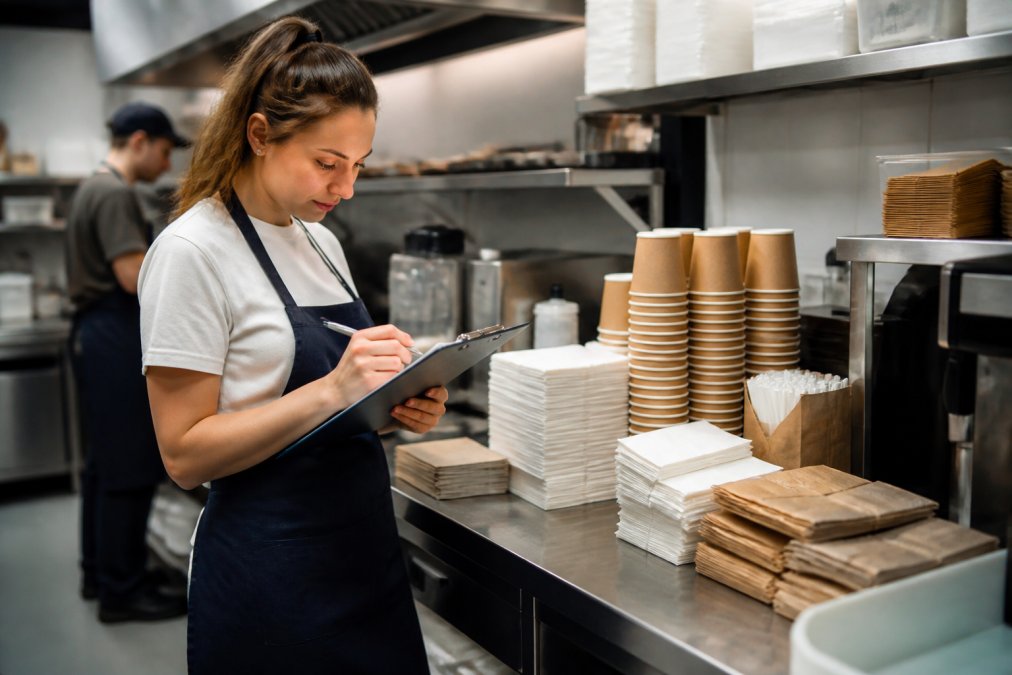
An audit is a one-week count of what leaves your storeroom, recorded by station, the highest-value exercise here because it replaces guesswork with numbers. Pick a normal trading week, count stock at the start and end, and log deliveries in between. The difference is your true usage.
Tracking Usage by Station and Shift
Break the count down by where supplies are consumed: front counter, kitchen pass, takeaway hatch, and till points. Then split it by shift. A Friday evening rush tells you something a weekly total never will.
Look for variance. If the evening shift burns twice the napkins of the morning shift with similar covers, the problem is how supplies are handed out, not volume.
Step 2: Buy Bulk Catering Disposables in Ireland the Smart Way
Bulk catering disposables buyers are told everywhere to order more and pay less per unit, advice that assumes you have the volume to reach the discount tier. Most independent cafés, takeaways and single-site restaurants do not, and that gap is where the real savings live.
Why the Standard Bulk Discount Model Fails Small Operators
A supplier's price break is usually triggered by a pallet quantity, minimum order value, or case count per line. If your weekly napkin usage is two cases, buying ten to hit the discount leaves nine sitting in a damp storeroom for two months, cash converted into slow-moving stock that may absorb moisture or go out of specification.
What matters is not price per unit but total cost of ownership per unit used, including storage space, cash tied up, spoilage, and the risk of ordering the wrong size when your menu changes.
Three Ways to Reach Bulk Pricing Without the Volume
1. Consolidate across categories, not within one. Suppliers often discount the whole order value rather than a single line. Buying till rolls, napkins, takeaway containers and cleaning disposables from one source may cross the threshold even when no single line does, the most effective move for a small operator.
2. Split a pallet with a neighbouring business. Two or three independent operators on the same street can place a combined order and divide it on delivery, getting the pallet rate while storing only their share. You need a written split agreement, a nominated person to order, and space to break the pallet safely.
3. Use a wholesaler's own brand for stable lines. Own-brand till rolls and napkins from a cash-and-carry are typically priced below branded equivalents at the same specification. Where the customer never sees the brand, till rolls, kitchen paper, bin liners, there is no reason to pay for a name.
Match Order Size to Audit Data, Not to Discount Tiers
Use your Step 1 numbers. If the audit shows 1,800 napkins a week, a case of 2,000 is roughly a week's cover; a case of 10,000 is five weeks of stock. Ask whether five weeks of storage is free in your premises, in most small kitchens it is not. That shelf space could hold sellable stock, and that cash could pay a supplier on time and earn better terms.
| Supply Type | Buying Approach | Why |
|---|---|---|
| Till rolls, napkins | Bulk, scheduled | Stable usage, no seasonal swing |
| Takeaway containers | Bulk with size mix | Demand shifts with menu changes |
| Seasonal or branded items | Small, frequent orders | Ties up cash if bought in bulk |
| Cleaning disposables | Add to consolidated order | Reaches order-value thresholds without extra storage risk |
Watch the Storage Conditions
Paper stock absorbs moisture, and a pallet stored in a damp back room or against an external wall can jam dispensers (Preliminary findings point to more slurry and soiled water storage needs - Teagasc). Keep bulk stock off the floor on racking, away from external walls, and rotate it so older stock is used first, a date label on each case is enough.
Step 3: Switch to Wholesale Thermal Till Rolls for Your POS
Wholesale thermal till rolls cut your cost per receipt in a way most operators never examine: a till roll has a fixed cost-per-metre, and buying at trade rates rather than retail changes that figure directly.
Two specifications decide whether a cheap roll is actually cheap. Roll diameter and core size must match your printer, or it will jam or run out mid-service. Paper grade affects how long receipts stay legible; a low-grade thermal coating fades faster, which matters for transactions you may need to reference later (pubmed.ncbi.nlm.nih.gov).
Check compatibility before committing to a box. A supplier that guarantees fit for leading PDQ and POS systems removes the main risk of switching. Next-day delivery means you are never caught short mid-week.
Step 4: Cut Paper Waste in Hospitality Without Cutting Corners
Reducing paper waste in hospitality starts with the dispenser, not the stockroom. Most waste is generated at the point of use, a design problem more than a discipline problem. Loose napkins on tables get grabbed in threes, while a dispenser releasing a fixed single sheet changes that behaviour without a staff briefing.
Dispenser Settings That Quietly Waste Money
Dispenser optimisation is the angle most cost-cutting guides skip. A napkin dispenser set to release a thick wad, or a till roll left on the spindle until the last centimetre, leaks money no invoice will show.
Step 5: Negotiate Better Terms With Your Supplier
Bring Your Audit Numbers to the Table
Prepare a one-page summary before you call:
The Four Terms Worth Negotiating, in Order of Value
What to Offer in Return
When to Walk Away
Keep the Agreement in Writing
Step 6: Choose Eco-Friendly Swaps That Don't Cost More
Step 7: Build a Replenishment System That Prevents Panic Orders
| System Element | What It Prevents | How to Set It |
|---|---|---|
| Par levels per line | Stockouts and over-ordering | Weekly usage plus 20% buffer |
| Fixed order day | Panic buying at premium prices | Match to your supplier's delivery schedule |
| Monthly usage review | Slow cost creep | Compare against the previous month |
| One owner per shift | Nobody checking stock | Assign by rota, not by seniority |
Frequently Asked Questions
How can restaurants reduce waste in paper supplies?
Start with a two-week usage audit: record how many napkins, cups and till rolls each station actually gets through. Then adjust dispenser settings, which often release more than customers need, and train staff to hand out napkins on request rather than by default. Many kitchens find that dispenser tweaks and simple portioning rules cut paper use noticeably without any drop in service quality.
Is it cheaper to buy restaurant paper supplies in bulk?
Usually yes, because the cost-per-unit drops as order size rises. Bulk buying also reduces delivery charges and the admin time spent reordering. The catch is storage: only order volumes you can store safely and use before the stock degrades. Match your bulk order to a realistic monthly usage figure so you get the unit price benefit without tying up cash in stock that sits in a damp back room.
What are the most cost-effective eco-friendly paper alternatives for catering?
Look for recyclable and BPA-free options first, since these often cost the same as standard lines when bought in bulk. Unbleached napkins, bagasse containers and paper straws are common swaps. Ask your supplier for a like-for-like comparison on unit price before committing, and test one product line at a time so you can measure the real cost impact rather than assuming green always means more expensive.
How do I choose a reliable supplier for thermal till rolls and napkins?
Check three things: compatibility guarantees for your POS system, delivery lead times to your area, and whether they offer account terms. A supplier who will confirm roll dimensions against your terminal model before you order a full box saves you the cost of returns. Ask about next-day delivery coverage outside the main cities if your site is rural, and request a sample roll to test before switching your whole supply.