


Bulk Storage Supplies: Organising Your Commercial Kitchen
Bernard ColganLast Updated: November 5, 2026
Quick Summary
Organise your commercial kitchen by sorting bulk storage supplies into separate zones for paper, plastic and compostable materials, labelling everything with a date and contents, and rotating stock First-In-First-Out so older packaging moves first. Set a minimum stock level for each item and assign one person to check the storeroom weekly.
- Keep dry goods and packaging off the floor and a shelf's depth away from walls for EHO checks.
- Store raw meat below ready-to-eat food and never above open packaging.
- Keep cleaning chemicals in a separate, locked cupboard away from food and disposables.
- Store cling film rolls in their box on a cool, dry shelf away from ovens.
- A case of 18" Catering Cling Film 300m gives 1,800 metres across six rolls.
Table of Contents
- Why Bulk Storage Supplies Decide How Smoothly Your Kitchen Runs
- FSAI Food Storage Guidelines Every Kitchen Should Follow
- Setting Up a Commercial Kitchen Inventory Management System
- Choosing the Right Bulk Storage Supplies for Each Material Type
- Space-Saving Storage Solutions for Small Kitchens
- Eco-Friendly Catering Disposables Ireland: Storing Them Without Waste
- Stocking Up with Discount Till Rolls
- Frequently Asked Questions
Why Bulk Storage Supplies Decide How Smoothly Your Kitchen Runs
Bulk storage supplies are the containers, wraps, bags and disposables a commercial kitchen buys in volume and stores before use. Get them right and service runs more smoothly.
The stakes are higher than most managers think. A kitchen with no clear storage system loses time on every shift. Bulk storage supplies fix that, but only when they are organised, labelled and stored with the same care as the food itself.
This guide from Discount Till Rolls, an Irish company based in Dublin, covers how to set up a commercial kitchen that stays tidy under pressure. Below, you'll find the exact steps to store disposables, manage stock and keep your kitchen compliant.
But first, here's what most guides get wrong: they treat packaging storage as an afterthought. It is not. Packaging touches food, so it falls under the same hygiene rules as your walk-in fridge.
FSAI Food Storage Guidelines Every Kitchen Should Follow
The Food Safety Authority of Ireland (FSAI) is the statutory body that oversees food safety in Ireland, and its guidance is enforced on the ground by environmental health officers (EHOs) attached to the HSE and by local authority inspectors. That distinction matters: the FSAI sets the standard, but an EHO can walk into a Dublin kitchen unannounced and ask to see your records. Storage is one of the first things they check, because it is where contamination is easiest to spot.
HACCP is the system most Irish kitchens use to manage this. It means identifying the points where food or packaging could go wrong, then putting a documented check in place. Storage is one of those points, and packaging counts because it touches food directly.
Here is what the FSAI approach means in practice for a kitchen storing bulk disposables:
- Keep dry goods and packaging off the floor and at least a shelf's depth away from walls, so an EHO can see behind and beneath stock
- Store raw meat below ready-to-eat food, never above it, and never above open packaging
- Keep cleaning chemicals in a separate, locked cupboard, ideally in a different room from food and disposables
- Record fridge and freezer temperatures daily, with a named person signing off each check
- Label everything with a date and contents, including opened cases of bags and film
- Train staff on the storage rules at induction and refresh the training at least annually, keeping a signed record
Moisture control matters too. A damp storeroom ruins cardboard packaging and encourages bacterial growth on any surface it touches. Ventilation and airflow keep dry storage genuinely dry, and a simple hygrometer on the wall gives staff something to check rather than guess at.
Watch out: a system that lives only in a manager's head is hard to demonstrate on inspection. Write it down, date it and keep it.
For kitchens building this from scratch, the bulk catering disposables buying guide for small cafés sets out how to match order quantities to real usage so stock does not sit long enough to become a storage problem.
Setting Up a Commercial Kitchen Inventory Management System
A commercial kitchen inventory management system is a written method for tracking what you have, what you need and when to reorder. It removes guesswork from ordering and stops staff running out mid-service.
Start with a simple stock sheet, not software. Walk the storeroom and count what is there. Then build your system around these steps:
- List every item you buy, from cling film to takeaway boxes
- Set a minimum level for each item
- Assign one person to check stock each week
- Record what leaves the store and when
- Review your order list before placing it
FIFO, or First-In-First-Out, is the backbone of this. New stock goes behind old stock. Staff take from the front. This keeps older packaging moving before it sits too long.
Small cafés building this system from scratch can lean on a bulk catering disposables buying guide for small cafés to match quantities to real usage.
Choosing the Right Bulk Storage Supplies for Each Material Type
Paper, plastic and compostable materials each need different storage conditions, so it helps to store them in separate zones. This section differentiates the three families so you can set up zones that actually protect the stock.
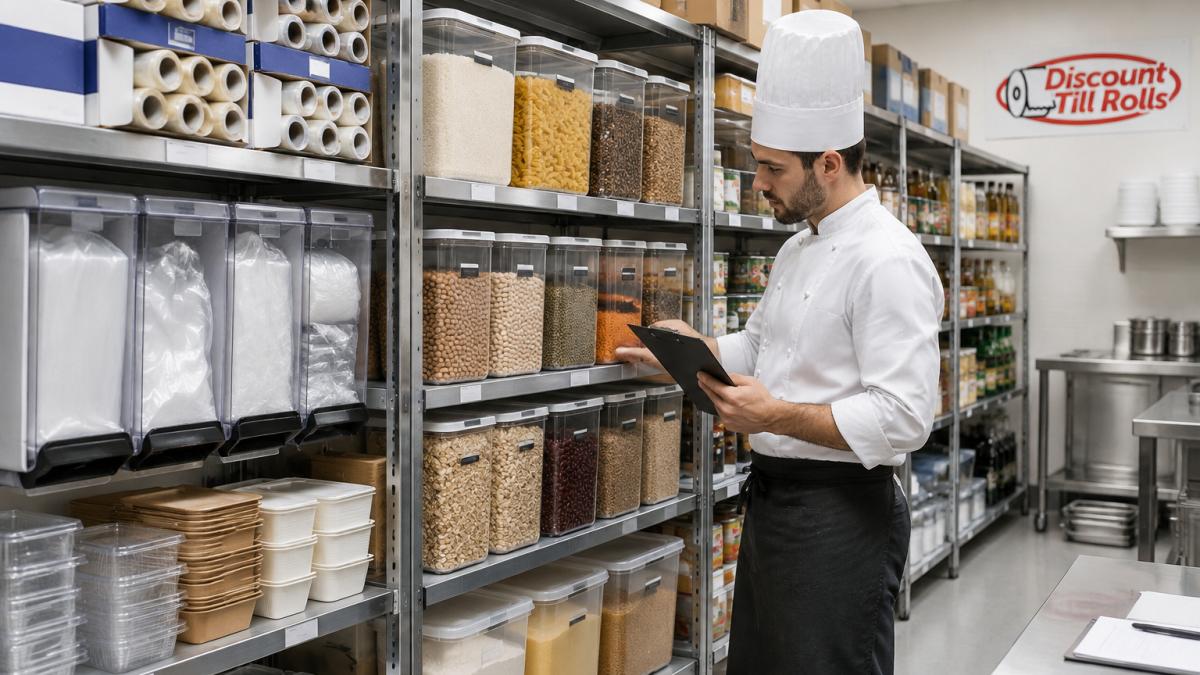
Paper and card. Takeaway boxes, napkins, wraps and paper bags absorb moisture from the air and from any damp surface they touch. Store them flat-stacked on a dry shelf, never directly on a concrete floor, and keep them away from sinks, dishwashers and steamy prep areas. Keep paper stock dry and covered, such as in a closed cupboard or lidded crate.
Plastic film and bags. Cling film softens and loses cling in heat, so keep rolls in their box on a cool, dry shelf away from ovens and hot lights. Food and freezer bags should stay in a sealed box off the floor to keep out dust and moisture.
Compostable and biodegradable items. Keep them dry, sealed and away from heat sources, and use them in date order so older stock moves first. Store eco stock on its own labelled shelf, separate from oils and chemicals.
Here is how the main material types map to storage:
| Material | Store it | Watch out for |
|---|---|---|
| Cling film rolls | Cool, dry shelf in the box | Heat softens the film and kills cling |
| Food and freezer bags | Sealed box, off the floor | Dust, moisture and chemical fumes |
| Cardboard takeaway boxes | Dry, flat-stacked, off concrete | Damp warps them and can taint food |
| Paper napkins and wraps | Closed cupboard or lidded crate | Grease, fumes and steam |
| Compostable lids and containers | Dry, sealed, away from heat | Heat and moisture start breakdown early |
| Cleaning chemicals | Locked, separate cupboard | Cross-contamination of any nearby stock |
For portion work, the Hero Double Seal Food & Freezer Bags 1L hold 1 litre with a double zip-seal closure and come with a description and allergen label printed on the bag. For larger batches, the Hero Double Seal Food & Freezer Bags 3.8L hold 3.8 litres with a double zip-seal closure.


Watch out: store food bags away from cleaning chemicals.
Space-Saving Storage Solutions for Small Kitchens
A small kitchen in Dublin does not need more space. It needs better use of the space it has. The goal is vertical storage, clear zones and supplies that take up less room per use.
Try these moves before you buy another shelf:
- Use wall-mounted racks above prep benches
- Store boxes on their sides so rolls pull out
- Keep daily-use items at waist height
- Put backup stock on the top shelf
- Use the inside of cupboard doors for small items
- Clear the floor completely for cleaning
Bulk cling film is a good example. A case of 18" Catering Cling Film 300m gives 1,800 metres across six rolls. Its 45cm width covers a full gastronorm pan in one pass.

Eco-Friendly Catering Disposables Ireland: Storing Them Without Waste
Eco-friendly catering disposables Ireland kitchens buy in bulk should be stored with the same care as any other stock. Keep them dry and sealed.
Store eco stock on its own labelled shelf. Keep it away from oils and chemicals, and use it in date order like everything else. If you are weighing up the switch, this piece on whether eco-friendly catering disposables are worth it breaks down the trade-offs before you commit shelf space.
Rotating and checking stock regularly helps reduce waste.
Stocking Up with Discount Till Rolls
Discount Till Rolls Ltd is an Irish company based in Dublin, at Unit 1 Naas Road Ind. Park, Old Naas Road, Bluebell, Dublin D12 DE7K. It supplies thermal paper rolls and catering disposables to retail and hospitality businesses across the country.
Ordering in bulk can reduce how often you reorder. Discount Till Rolls offers trade pricing and bulk order discounts, and next-day delivery.
You can reach the team on +353 (0)1 443 3964 or at Sales@discounttillrolls.ie. If you are searching for bulk storage supplies near me in Dublin, a single supplier for packaging and till rolls saves both time and admin.
The takeaway is simple. Sort your storeroom by material, label it, set minimum stock levels and rotate on FIFO. Do that and the kitchen runs smoother on every shift.
Frequently Asked Questions
What do the FSAI food storage guidelines require for dry goods in a commercial kitchen?
The FSAI expects dry stores to be cool, dry and well ventilated, with stock kept off the floor on shelving and protected from pests. Containers should be food-grade, sealed and labelled with contents and dates, and you should follow FIFO rotation. Your HACCP plan needs to show how you monitor these conditions and train staff. Always check the current FSAI guidance directly, as requirements can be updated.
How can I manage bulk catering disposables in a small kitchen without clutter?
Use vertical shelving and stackable containers, keep only a week's worth of stock on the line and store the rest in a separate dry store. Label each box with the date received and use the oldest first. Collapsible or nesting containers help, and buying in case quantities rather than loose packs reduces packaging waste. A simple weekly stock check stops overordering in tight spaces.
What is the best way to label bulk storage containers for food safety?
Label every container with the food name, date prepared or opened, and use-by date. Allergen information must be clear, especially for made-in-house sauces and mixes. Use waterproof labels or printed allergen bags where possible. Keep a labelling protocol in your HACCP documentation and train staff so anyone can identify contents at a glance. This also supports traceability if a product is recalled.
What are the benefits of eco-friendly bulk packaging for Irish cafes?
Eco-friendly disposables help you meet growing customer expectations and can reduce waste sent to landfill. Buying in bulk cuts per-unit costs and packaging, and many recyclable options now perform as well as standard ones. Check that products are genuinely recyclable or compostable in Irish waste streams, and store them dry to keep them fit for use. Discount Till Rolls offers catering disposables with next-day delivery.
