


Are Eco-Friendly Catering Disposables Worth It?
Bernard ColganTable of Contents
- Are eco-friendly catering disposables worth it?
- What does switching to eco disposables cost per serve?
- When is a bagasse plate worth the extra cost?
- When is a paper plate the better buy?
- Is a plastic-free coffee cup worth about 3c more?
- Will compostable packaging actually get composted?
- How do you test the switch before buying in bulk?
- Frequently Asked Questions
Last Updated: October 17, 2026. Prices checked on DiscountTillRolls.ie the same day.
Are eco-friendly catering disposables worth it?
Mostly, yes. On our own prices, a plastic-free coffee cup and lid costs about 3c more than a standard one, and a bagasse dinner plate costs about 4.6c more than a paper one. That's worth paying where the food is hot, wet or greasy. For cold, light food, paper does the job for less.
So the real question isn't "eco or not". It's which format, for which dish. Below is what each switch costs per serve, where it earns its money and where it doesn't. Every price is ex VAT, taken from DiscountTillRolls.ie on 17 October 2026.
What does switching to eco disposables cost per serve?
Here's the side-by-side on the four lines most cafés and caterers ask us about. Case price first, then the cost per unit.
Item |
Cheaper option |
Eco upgrade |
Extra per unit |
|---|---|---|---|
8oz double wall coffee cup |
8oz White Matte, PE lined: €37.80 + VAT per 500 (7.6c each) |
8oz Greenspirit, aqueous lined: €43.80 + VAT per 500 (8.8c each) |
1.2c |
8oz cup lid (80mm) |
80mm Black Lid: €27.60 + VAT per 1000 (2.8c each) |
80mm Aqueous Paper Lid: €45.99 + VAT per 1000 (4.6c each) |
1.8c |
9" dinner plate (228mm) |
9" White Greenspirit Paper Plate: €41.99 + VAT per 1000 (4.2c each) |
9" Bagasse Plate: €43.84 + VAT per 500 (8.8c each) |
4.6c |
7" side plate |
7" White Greenspirit Paper Plate (180mm): €38.66 + VAT per 1000 (3.9c each) |
7" Bagasse Round Plate (154mm): €47.99 + VAT per 1000 (4.8c each) |
0.9c |
Put a cup and lid together and a standard 8oz coffee comes to about 10.3c in packaging. The plastic-free version is about 13.4c. That's roughly 3c a coffee. Note the 7" plates aren't the same size: the bagasse one is 154mm across, the paper one 180mm.
There's no plastic plate column because single-use plastic plates have been banned across the EU since July 2021. For plates, the choice is paper or bagasse. More on why in our guide to alternatives to plastic takeaway packaging.
When is a bagasse plate worth the extra cost?
When the food is hot, saucy or oily. Bagasse is pressed sugarcane fibre. The manufacturer lists our 9" plate as grease and leak resistant, microwave safe and freezer safe, with no plastic lining or wax coating. Our paper plates are listed for ambient and lightly warm food only, not very hot or oily food.
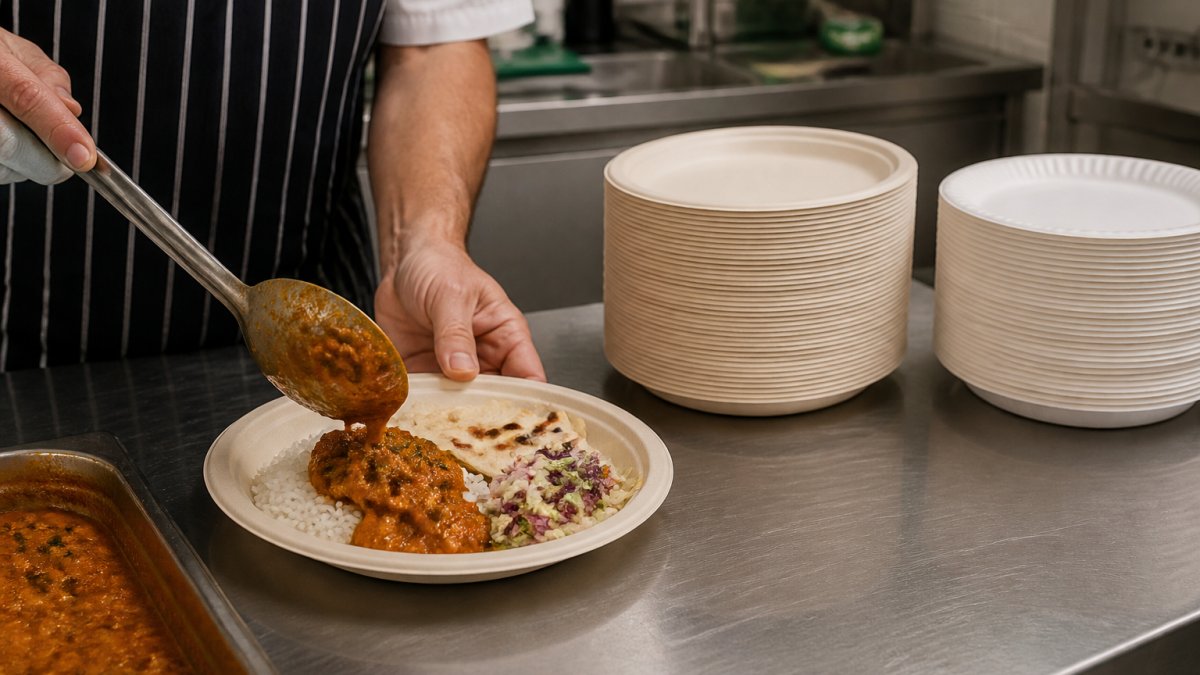
So for curry, chips, pasta bakes or a carvery plate, the extra 4.6c is cheap insurance. One plate folding onto a customer costs you far more than the 4.6c you saved. For hot food going out in a box rather than on a plate, see bagasse vs kraft vs plastic takeaway containers.

When is a paper plate the better buy?
For anything cold or lightly warm: sandwiches, cake, canapés, buffet starters. Bagasse buys you nothing there, so don't pay for it. The 6" White Greenspirit Paper Plate works out at 2.4c each (€47.20 + VAT per 2000) for desserts and bar snacks.
Most menus need both. Run paper for cold and ambient, bagasse for hot mains. Our disposable plates guide covers sizes, and the full range is in Plates & Bowls.
Is a plastic-free coffee cup worth about 3c more?
If you tell customers your cups are plastic-free, yes, because a PE-lined cup isn't. Greenspirit's aqueous cups use a water-based lining with no PE and no PLA. The manufacturer lists them as home compostable within 24 weeks and re-pulpable in paper recycling.

Say you sell 300 coffees a week: at 3c a cup, that's about €9 + VAT a week. Whether that's worth it depends on your customers and your bins. If nobody asks and your cups go in general waste either way, the standard cup does the same job. The lining differences are explained in how to choose a plastic-free coffee cup, and every option is in Compostable Coffee Cups & Lids.

Will compostable packaging actually get composted?
Only if your bin and your waste contractor take it. Some compostable items, like PLA lids and our Greenspirit soup containers (EN13432 certified), need commercial composting and won't break down at home. Others, like the aqueous cups, are listed as home compostable.
What the labels actually mean is covered in compostable vs biodegradable vs recyclable.
How do you test the switch before buying in bulk?
Pick one menu section, order one case, and run it for two weeks. Count how many plates fail or cups leak, and ask your team what customers say. That tells you more than any label. If you're weighing up a new supplier at the same time, see how to vet a sustainable catering supplier.
DiscountTillRolls.ie has supplied Irish cafés, restaurants and caterers from Dublin 12 since 2007. Browse the Compostable Takeaway Containers range or email sales@discounttillrolls.ie for a price on bigger volumes.
Frequently Asked Questions
Are eco-friendly catering disposables worth the extra cost?
For hot food and coffee, mostly yes. On DiscountTillRolls.ie prices, a plastic-free 8oz cup and lid costs about 3c more than a PE-lined cup with a standard lid, and a 9" bagasse plate costs 4.6c more than a 9" paper plate (all + VAT). For cold, light food, paper plates do the job for less.
How much more does a plastic-free coffee cup cost?
About 1.2c per cup. The 8oz Greenspirit aqueous double wall cup is €43.80 + VAT per 500 (8.8c each), against €37.80 + VAT per 500 (7.6c each) for the 8oz White Matte PE-lined cup. Add a plastic-free aqueous paper lid and the gap is about 3c per coffee.
Are bagasse plates suitable for hot food?
Yes. Bagasse is pressed sugarcane fibre, and the manufacturer lists our 9" bagasse plate as grease and leak resistant, microwave safe and freezer safe, with no plastic lining or wax coating. Our paper plates are listed for ambient and lightly warm food only, so use bagasse for curries, chips and hot mains.
Can compostable packaging go in the brown bin in Ireland?
It depends on your waste contractor. Some items, like PLA lids and EN13432 certified soup containers, need commercial composting. Others, like Greenspirit aqueous cups, are listed by the manufacturer as home compostable within 24 weeks. Ask your contractor what they accept before you buy a full case.
What is the cheapest compostable plate?
The 6" White Greenspirit Paper Plate, at 2.4c each or €47.20 + VAT for a case of 2000. It's listed for commercial composting and suits desserts, canapés and bar snacks. For a hot main course, step up to the 9" bagasse plate at 8.8c each.