


Why Thermal Paper Fades Quickly: Causes & Solutions
Bernard ColganTable of Contents
- How Thermal Paper Works and Why It Fades
- The Chemical Reaction Behind Thermal Paper Fading
- Environmental Factors That Accelerate Fading
- How to Store Thermal Paper Rolls for Longevity
- Phenol Free Thermal Paper and Fade Resistance
- Understanding Thermal Paper Shelf Life
- Choosing the Right Paper Grade for Your Needs
- Why Thermal Paper Fades Quickly: The Bottom Line
- Frequently Asked Questions
Last Updated: September 23, 2026
How Thermal Paper Works and Why It Fades
Thermal paper is a clever material. Heat activates a chemical coating that creates an image without ink or toner. When you swipe a card or print a receipt, the printhead gets hot. That heat triggers a reaction in the coating, and the text appears.
But here's the problem: the same heat that creates the image can also destroy it. Light, humidity, and temperature all speed up the fading process. This is why thermal paper fades quickly under the wrong conditions.
At Discount Till Rolls, we supply thermal paper rolls to retailers and hospitality businesses who face this challenge every day. A receipt that's illegible in six months isn't just inconvenient, it's a compliance risk. Irish and EU financial record-keeping rules require transaction records to be retained for a minimum of 6 years.

Understanding why your receipts fade helps you choose the right paper and store it properly. The difference between a receipt that lasts one year and one that lasts ten years comes down to the paper grade, the chemicals used, and how you store it.
The Chemical Reaction Behind Thermal Paper Fading
The coating on thermal paper holds two main ingredients: a colourless dye and a developer. When the printhead heats the coating, the two combine and the dye turns black. That's your printed text.
Fading happens when that bond slowly breaks apart and the dye goes back to being colourless. Light, plasticisers, oils, solvents and humidity all speed this up. Nothing stops it completely, but good paper and good storage slow it down a lot.
Heat works a bit differently. Too much heat after printing tends to darken thermal paper rather than fade it, so the whole receipt turns grey and the text gets lost in the background. Either way, the result is the same: a receipt you can't read.
What actually decides how long a print lasts
- Coating grade: Long-life (sometimes called archival) coatings are formulated to hold the image for much longer than standard coatings. This is the biggest factor.
- Top coat: Some papers add a protective layer over the thermal coating that shields it from oils, moisture and plasticisers.
- Storage: Even the best paper fades early if it's kept in the wrong place.
GSM (grammes per square metre) tells you how heavy the paper is, not how long the print lasts. Our 80x80 80GSM Long Life Thermal Till Rolls happen to be heavier paper, but it's the long-life coating that gives them their fade resistance.
Environmental Factors That Accelerate Fading
Thermal paper doesn't fade at the same speed everywhere. Your storage conditions matter more than most people realise.
Heat and Temperature Exposure
Heat is the enemy of thermal paper. The same printhead heat that creates the image will also trigger fading if the paper gets too warm after printing.
Keep receipts away from:
- Direct sunlight
- Heat sources like radiators or ovens
- Hot vehicles
- Warm storage cupboards
A receipt left on a sunny windowsill can fade in days. The same receipt in a cool, dark drawer might last years.
Temperature swings are also a problem. If your storage moves from cold to warm repeatedly, the paper breaks down faster. Stability matters more than absolute temperature.
Light and UV Radiation
Light is the second major fader of thermal paper. UV rays from sunlight accelerate the chemical breakdown. Even indoor fluorescent lights can cause slow fading over months.
Receipts stored in clear plastic or transparent containers fade faster than those in opaque boxes. The light gets through.
Keep your rolls in:
- Closed, opaque storage boxes
- Dark cupboards or drawers
- Away from windows and bright lights
A till roll left on a counter under shop lights will fade noticeably within weeks.
Humidity and Moisture
Heat is where thermal paper starts, and it's also where a lot of problems start. Once a receipt is printed, extra heat can darken the whole sheet until the text blends into the background. Unused rolls are affected too: a box left somewhere warm can grey before it ever goes in the printer
Low humidity isn't ideal either. Extremely dry air can make the paper brittle and cause the coating to crack.
Aim for moderate humidity:
- Between 40% and 60% relative humidity
- Avoid damp basements or cellars
- Keep paper away from sinks and water sources
- Don't store rolls in unheated sheds
A roll exposed to rain or spilled liquid becomes unreadable immediately. Even high humidity over weeks will degrade the coating.
Plastic Wallets, Hand Cream and Sanitiser
This is the one most people don't expect. Many soft plastics, especially PVC, contain plasticisers that slowly migrate into anything they touch. Put a thermal receipt in a PVC sleeve, a plastic document wallet or a leather-look purse and the text can disappear in weeks.
Oils and alcohol do similar damage. Hand cream, greasy fingers and alcohol hand sanitiser can all leave blank patches where the receipt was handled.
To protect receipts you need to keep:
- Store them in paper envelopes or cardboard boxes, not PVC sleeves
- Don't laminate thermal receipts, as the heat and plastic both damage the print
- Handle them with clean, dry hands
- Scan or photograph anything important. A digital copy doesn't fade.
How to Store Thermal Paper Rolls for Longevity
The way you store thermal paper makes the difference between receipts that fade in months and ones that last years.
Start with the basics. Keep rolls in their original boxes if possible. The cardboard protects them from light and dust. If you transfer them, use opaque plastic containers instead of clear ones.
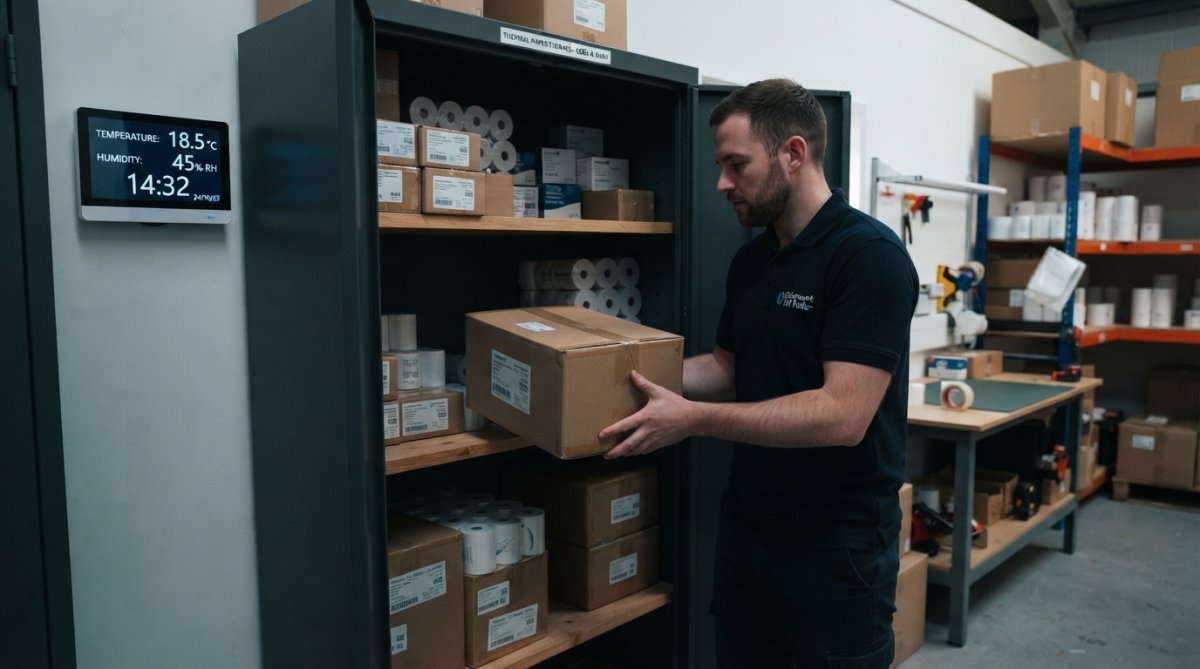
Temperature control is essential. Store paper in a cool room, around 18-24 degrees Celsius is ideal. Avoid attics, unheated storage areas, and anywhere that gets direct sun. A cool cupboard in your office or stockroom is better than a garage.
Humidity matters too. If you transfer them, use a cardboard box or an opaque polypropylene container. Avoid PVC, which can damage the coating.
. Many retailers in Dublin use simple digital monitors to track temperature and humidity. They cost little and catch problems early.
Stack rolls flat rather than standing upright. This prevents the bottom rolls from getting crushed and damaged. Don't stack too high, three or four boxes deep is enough.
Keep the oldest rolls at the front. Use them first. This simple rotation prevents paper from sitting unused for years.
Phenol Free Thermal Paper and Fade Resistance
BPA is a bisphenol, one of a family of phenol-based developers used in thermal coatings. Since January 2020, EU rules have restricted BPA in thermal paper, so compliant rolls sold here shouldn't contain it. Many manufacturers switched to BPS, a close chemical cousin.
Phenol-free paper goes a step further and uses no bisphenol developers at all. That's mainly a handling choice. Staff who touch receipts all day have less contact with these chemicals.
Here's the part that trips people up: phenol-free does not automatically mean longer lasting. Fade resistance comes from the coating grade and top coat, not from which developer is used.
If you want both, look for paper that is phenol-free and rated for long image life. You can browse our phenol-free thermal rolls, or go for our long-life 80GSM rolls if record retention is the priority.
Key TakeawayPhenol-free is a handling choice. Long-life coating is a fade-resistance choice. One doesn't guarantee the other.
Understanding Thermal Paper Shelf Life
Thermal paper has two different lifespans. One is how long it lasts before you use it. The other is how long the printed image lasts after printing.
Unused paper degrades slowly over time, even in perfect storage. A roll that sits for five years will have a weaker coating than a fresh roll. But if stored well, it will still print fine.
The printed image is what matters for compliance and records. A receipt printed today needs to stay readable for as long as you're required to keep records.
Printed image life depends on the coating grade and on storage
- Standard thermal paper: Fine for customer receipts, but not designed for long-term records. Expect noticeable fading within a few years, sooner in poor conditions.
- Long-life thermal paper: Rated by the manufacturer for up to 10 years' image life when stored correctly.
For financial records, the rule is simple. Revenue generally requires business records to be kept for six years, so any receipt you hold onto should be printed on paper rated for at least that long, or scanned.
Storage conditions directly affect how long the printed image lasts. A receipt stored in a cool, dark place lasts longer than one exposed to heat and light.
For financial records, the rule is simple: if you must keep receipts for six years, use paper rated for at least that duration.
Choosing the Right Paper Grade for Your Needs
The right paper depends on what you do with the receipts after printing.
Consider your business type:
- Retail shops: Standard 65 GSM if receipts leave with customers; long-life 80 GSM if you keep copies
- Restaurants and cafés: Long-life paper if you retain copies for reconciliation
- Hotels and credit unions: Long-life paper for compliance and audit trails
- Betting shops: Long-life paper for regulatory requirements
Why Thermal Paper Fades Quickly: The Bottom Line
Thermal paper fades because the chemical bond that creates the print slowly breaks down. Light, plasticisers, oils and humidity speed that up, and too much heat darkens the paper instead. You can't stop it completely, but you can slow it down a lot.
Three things make the biggest difference:
- Use long-life paper for any receipt you need to keep.
- Store it cool, dark and dry, in cardboard rather than plastic.
- Scan anything important, because a digital copy never fades.
Not sure which roll fits your printer? Check our Which Till Roll Do I Need? guide, or browse 80mm thermal rolls and credit card rolls. Every order ships from our Dublin warehouse.
Frequently Asked Questions
Why do thermal receipts turn blank over time?
Thermal paper contains a heat-sensitive coating that darkens when exposed to heat during printing. Over time, ambient heat, light exposure, and humidity cause the chemical dyes in this coating to fade naturally, making the text disappear. Standard thermal paper typically fades within 2–3 years under normal conditions. Higher GSM grades and long-life formulations resist fading longer; for instance, 80GSM long-life rolls maintain legibility for up to 10 years when stored correctly, making them essential for compliance records.
How should I store thermal paper rolls in my Dublin office?
Store thermal rolls in a cool, dry place away from direct sunlight, heat sources, and humidity. Keep rolls in their original packaging or sealed containers to protect them from air and moisture. Avoid storing near radiators, windows, or damp areas. Rotate stock using FIFO (first in, first out) to use older rolls before newer ones. Proper storage extends shelf life significantly and preserves print quality for financial records and compliance purposes.
Is phenol-free thermal paper more resistant to fading?
Phenol and BPA are different chemicals. Being phenol-free does not make paper more fade-resistant; fade resistance depends on the paper's GSM weight, coating chemistry, and storage conditions. For maximum fade resistance, choose a higher GSM grade (such as 80GSM) combined with proper storage, regardless of whether the paper is phenol-free or BPA-free.
What environmental factors accelerate thermal paper degradation?
Heat, light, humidity, and chemical exposure are the primary culprits. High temperatures speed up the fading process. Direct sunlight and fluorescent lighting degrade the thermal coating over time. High humidity causes moisture absorption, which can blur or darken prints prematurely. Exposure to oils, solvents, and certain chemicals also damages the coating. Storing rolls away from these conditions—in a temperature-controlled, dark, dry space—is the most effective way to preserve print longevity and maintain legibility for regulatory compliance.