


How to Calculate Incremental Sales From Receipt Coupons
Bernard ColganQuick Summary
To calculate incremental sales from receipt coupons, take what you sold while the coupon ran and subtract what you would have sold without it. Get the "without" figure from a baseline or a control period with no coupon. Then work it out in profit, because the discount comes off every redeemed sale, including the ones you would have got anyway.
- Incremental sales = sales with the coupon − expected sales without it.
- Sales lift % = incremental sales ÷ expected sales × 100.
- Measure over the print days and the redemption window, because receipt coupons come back on a later visit.
- Use figures net of VAT on both sides.
- Worked example: €600 extra sales is a 15% lift, but only €280 extra gross profit.
Table of Contents
- What are incremental sales from a receipt coupon?
- What baseline do you need before the campaign?
- How do you set up a control group in a small shop?
- What is the incremental sales formula?
- How much did the coupon really make? A worked example
- Why is redemption rate not the same as incremental sales?
- What stops the numbers being accurate?
- Which receipt rolls keep coupon codes readable?
- Frequently Asked Questions
How to Calculate Incremental Sales From Receipt Coupons
Last Updated: November 3, 2026
What are incremental sales from a receipt coupon?
Incremental sales are the extra sales a receipt coupon brings in that you would not have got without it. They are not the total takings on coupon transactions. Plenty of the people who hand a coupon back are regulars who would have come in anyway.
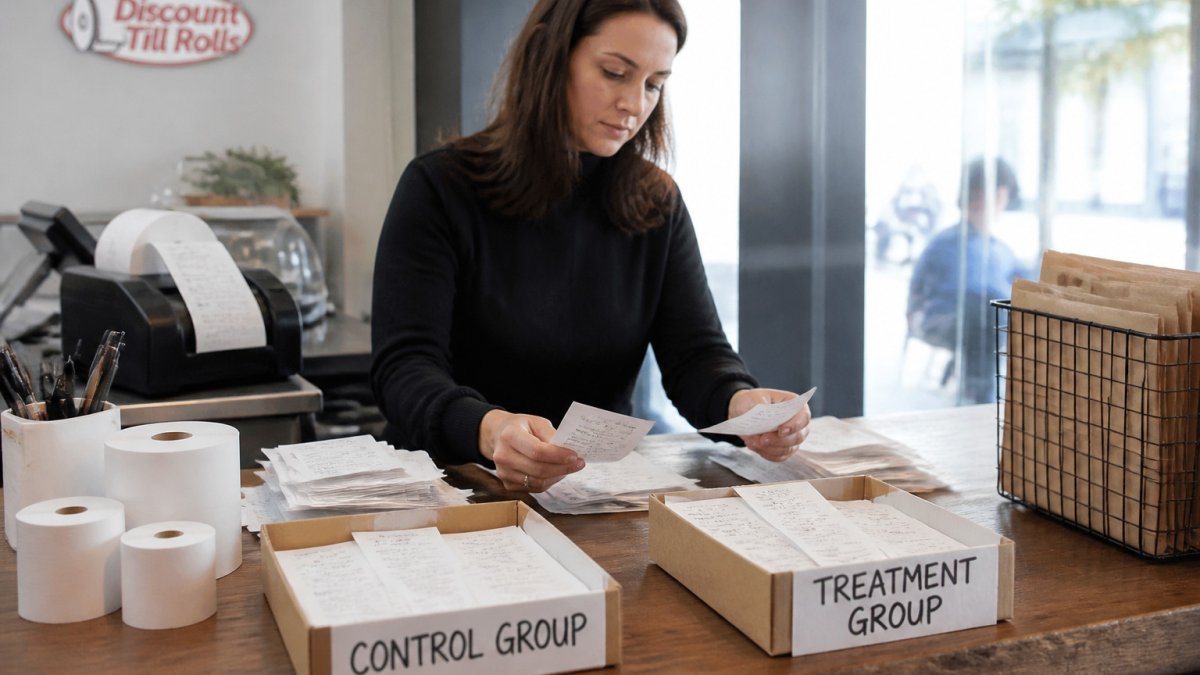
Three numbers matter:
- Redemptions: every coupon handed back and accepted.
- Incremental sales: only the sales the coupon actually created.
- Give-away: the discount handed to customers who would have paid full price.
If you only need the redemption count, see how to measure receipt coupon redemption rates. This guide picks up where that one stops: did the coupon make you money?
What baseline do you need before the campaign?
Your baseline is what you normally sell with no coupon running. Every result gets compared against it. Without one, any rise could just be a good week.
- Pull a few weeks of till reports from before the campaign, or a full season if your trade is seasonal.
- Compare the same days of the week.
- Leave out odd days: bank holidays, a till down, a big event nearby.
- Track number of transactions and average spend separately. A coupon can lift either one.
- Use net of VAT figures throughout. Mixing VAT-inclusive and VAT-exclusive numbers is the easiest way to get the maths wrong.
Don't compare a coupon week in December with a quiet week in November. Like with like.
How do you set up a control group in a small shop?
A control group is the same trade with no coupon. Compare the two and the difference is what the coupon did.
- One shop: split by time. Run the coupon for a set period, then run the same days with no coupon. Repeat if you can.
- More than one branch: run the coupon in some branches and hold others back. Pick branches with similar takings and footfall.
- Keep everything else the same: same dates or days, no other offers, no price changes during the test.
Receipt coupons print on one visit and get redeemed on a later one. So measure over the full redemption window, not just the days the coupon printed. If you split by time, wait until the redemption window has closed before your no-coupon period starts.
Write the dates down before the first coupon prints, so nobody moves the goalposts after.
What is the incremental sales formula?
Incremental sales = sales during the coupon period − expected sales without the coupon
Sales lift % = (incremental sales ÷ expected sales) × 100
- Total your net sales for the coupon period from the till reports.
- Work out expected sales for the same period from your baseline or control.
- Subtract expected from actual. That is your incremental sales.
- Divide by expected sales and multiply by 100 for the lift.
- Work out gross profit on both sides, after discounts. That is the number that tells you whether it paid.
How much did the coupon really make? A worked example
Take a café that normally does €4,000 net over a fortnight at a 60% gross margin. It prints a €2 off coupon on every receipt. Over the coupon fortnight it takes €4,600 net, after 100 coupons were redeemed.
Figure |
Without coupon |
With coupon |
|---|---|---|
Net sales (after discounts) |
€4,000 |
€4,600 |
Discounts given |
€0 |
€200 (100 × €2) |
Cost of goods (40% of full-price value) |
€1,600 |
€1,920 |
Gross profit |
€2,400 |
€2,680 |
- Incremental sales: €4,600 − €4,000 = €600.
- Sales lift: €600 ÷ €4,000 × 100 = 15%.
- Incremental gross profit: €2,680 − €2,400 = €280. That is an 11.7% lift in profit, not 15%.
The gap is the discount. Some of those 100 redeemers were regulars who would have spent anyway, so part of the €200 went for nothing. The control comparison catches that, which is why you need one.
Take off anything else the campaign cost, like staff time or a POS setup charge, and you have the real return. If there is little left, the coupon kept staff busy and moved very little.
Why is redemption rate not the same as incremental sales?
Redemption rate tells you how many coupons came back. Incremental sales tell you how much of that trade was new. They answer different questions, so keep them in separate columns.
A coupon can post a high redemption rate and still lose money if every redeemer was a regular. A lower rate that brings in new customers can be the better result. For the redemption formula and how to log codes at the till, see how to measure receipt coupon redemption rates accurately.
What stops the numbers being accurate?
- Overlapping offers. Two promotions at once and you can't tell which one did the work.
- No control. Without one, weather, paydays and local events look like coupon lift.
- Redemptions not logged. Use one code per campaign, printed from the till footer, and key it in at the till every time. Then the till report does the counting.
- Gross and net mixed up. Keep everything net of VAT.
- Unreadable codes. A code that has faded in a wallet is a lost redemption and a wrong count. Why thermal paper fades covers the causes and how to store rolls.
- Running out of rolls mid-test. A busy coupon week uses more paper. See how to calculate thermal paper usage.
Which receipt rolls keep coupon codes readable?
The coupon only counts if it prints clean and still reads when it comes back.
- The right size for your printer. Match width x diameter and the core. Not sure? Ring us on 01 443 3964 before you order.
- A heavier roll. Our 80x80 80gsm long life thermal till rolls are €36.99 + VAT for a box of 20, about €1.85 a roll.
- Phenol-free if you need it. See our phenol-free thermal paper rolls.

Do a wallet test before launch: print a coupon, keep it in a wallet for a week, and check it still reads.
For what to print and how to word the offer, see receipt marketing ideas. To cut waste while you test, see how to reduce receipt paper waste in a busy cafe.
DiscountTillRolls.ie is an Irish supplier at Unit 4, Naas Road Ind. Park, Dublin 12, trading since 2007. Order your thermal till rolls before 1pm, shipped at 2pm, or call and collect from Dublin 12. Ring 01 443 3964 or email Sales@discounttillrolls.ie.
Frequently Asked Questions
What are incremental sales from a receipt coupon?
Incremental sales are the extra sales a receipt coupon created that you would not have made without it. They are not the total takings on coupon transactions, because many redeemers would have bought anyway. Work them out by comparing the coupon period with a baseline or a no-coupon control period, using net of VAT figures on both sides.
How do you calculate incremental sales lift?
Subtract expected sales without the coupon from actual sales during the coupon period, divide by expected sales and multiply by 100. If a normal fortnight brings in €4,000 net and the coupon fortnight brings in €4,600, that is €600 incremental and a 15% lift. Then check gross profit after discounts before calling it a win.
How do you set up a control group for a receipt coupon in one shop?
Split by time. Run the coupon for a set period, then run the same days with no coupon, starting only after the redemption window has closed. Keep prices and other offers the same in both. Write the dates down before the first coupon prints so the comparison stays fair.
Why can a receipt coupon raise sales but not profit?
Every redeemed coupon takes the discount off the sale, including sales to regulars who would have paid full price. In our worked example a 15% sales lift was only an 11.7% lift in gross profit once €200 in discounts came off. Always finish the calculation in profit, not takings.
Is redemption rate the same as incremental sales?
No. Redemption rate is coupons redeemed divided by coupons issued. It shows how many came back, not whether they brought in new trade. A coupon can have a high redemption rate and add very little if most redeemers were regulars. Track both, in separate columns.
