


How to Measure Receipt Coupon Redemption Rates Accurately
Bernard ColganLast Updated: October 30, 2026
Quick Summary
To measure receipt coupon redemption rates accurately, divide coupons redeemed by coupons issued and multiply by 100. Take the issued count from your till, not from rolls ordered. Log each redemption at the till as it happens, and only count codes used inside a fixed redemption window.
- Every campaign needs three numbers: coupons issued, coupons redeemed and a fixed window.
- Example: 640 coupons issued and 51 redeemed is an 8.0% redemption rate.
- Give each offer its own code so the till logs it like any other discount.
- Compare against your own past campaigns and a week with no coupon running.
- A high rate on a thin margin can still lose money, so track spend and margin too.
Table of Contents
- What do you need to measure a receipt coupon campaign?
- What is the coupon redemption rate formula?
- How do you track coupons printed on till receipts?
- What is a good coupon redemption rate?
- Which metrics matter beyond the redemption rate?
- What mistakes distort coupon redemption numbers?
- Which receipt rolls help coupon tracking?
- How do you set up your next receipt coupon campaign?
- Frequently Asked Questions
What do you need to measure a receipt coupon campaign?
You need three numbers before you can work out any rate: how many coupons were issued, how many came back, and the dates the offer was valid. Get those right and the maths is easy. Get one wrong and every figure after it is wrong too.
- Coupons issued: the number of receipts that printed the coupon during the campaign. Your till report gives you this.
- Coupons redeemed: the number handed back and accepted at the till.
- Redemption window: the fixed dates the offer is valid.
Most shops only count the second number. Without a clean issued count you have nothing to divide by.
What is the coupon redemption rate formula?
The coupon redemption rate formula is coupons redeemed divided by coupons issued, multiplied by 100. That gives a percentage you can compare across campaigns, weeks and branches.
Redemption rate = (coupons redeemed ÷ coupons issued) × 100
A shop that issues 1,000 coupons and takes back 40 has a 4% rate. A shop that issues 200 and takes back 40 has a 20% rate. Same redemptions, very different result.
- Count issued coupons from the till, not from paper ordered. Spoiled or unused rolls are not issued coupons.
- Only count redemptions inside the window. A code taken after the end date is not a valid redemption for that campaign.
Worked example: a weekend coffee offer
Say a café prints a coupon on every receipt over one weekend: a free coffee with any sandwich, valid until the following Friday.
Figure |
Number |
|---|---|
Coupons issued (Saturday and Sunday) |
640 |
Coupons redeemed by Friday |
51 |
Redemption rate |
(51 ÷ 640) × 100 = 8.0% |
That 8.0% becomes the baseline. The next weekend offer gets judged against it, not against a feeling that it went okay.
How do you track coupons printed on till receipts?
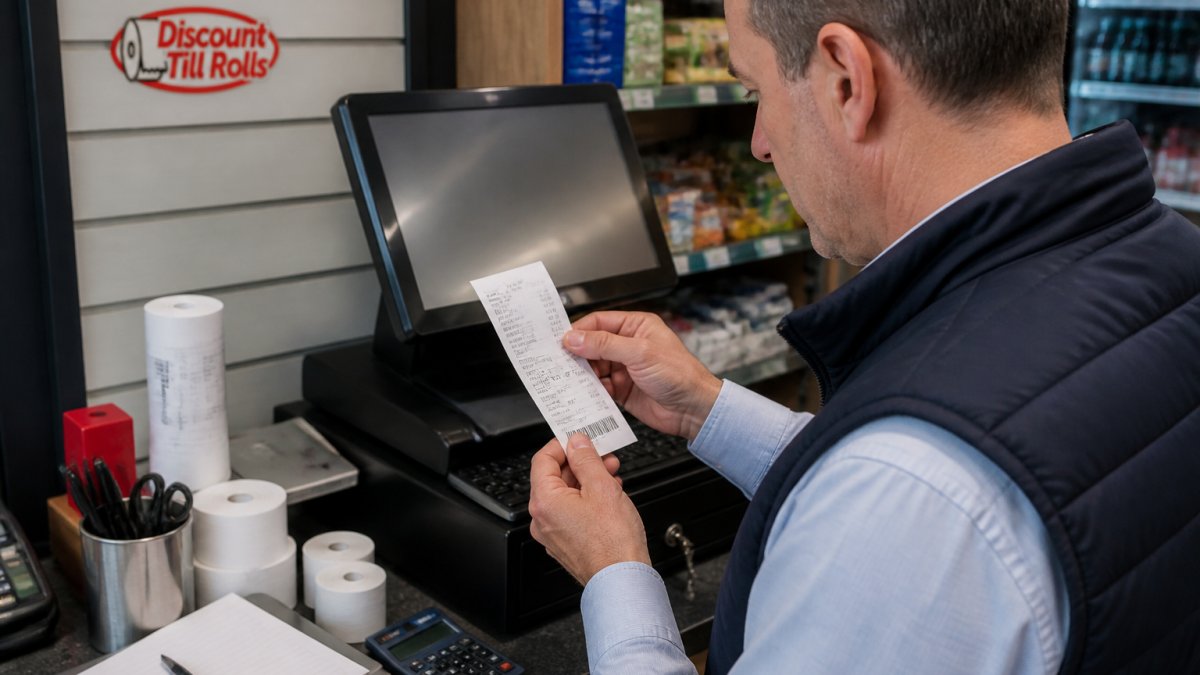
Give every campaign its own short code and have staff key it in at the till as a discount. The till then counts redemptions for you, and the report shows issued and redeemed side by side.
- One code per campaign. Something short like WEEKEND10.
- Print it from the till footer. Dated codes belong in the footer, which you can change any day, not on pre-printed rolls.
- Log every redemption at the till. No code keyed in, no redemption counted.
- Keep the redeemed slips in a box under the counter until the window closes.
- Reconcile weekly. Match the till count against the slips you hold.
For what to print and how to word the offer so people use it, see receipt marketing ideas.
What is a good coupon redemption rate?
There is no single figure that fits every business. The offer, the product, the customer and the window length all move the rate, so a good rate is one that beats your own last campaign on similar terms.
Compare like with like:
- Your own past campaigns on the same product
- Other branches running the same offer
- The same offer on a different day or season
Also run a control. Pick a comparable week with no coupon running and compare sales of the product. If sales barely move when the coupon is on, the coupon is not doing the work. A short window usually pushes urgency; a long one brings more redemptions in total but a flatter weekly rate.
Which metrics matter beyond the redemption rate?
The redemption rate tells you how many came back, not whether the campaign made money. Add these to the weekly review:
Metric |
How to work it out |
|---|---|
Average spend per redemption |
Total spend on redeemed transactions ÷ redemptions |
Cost per redemption |
Total campaign cost (discounts given plus any print cost) ÷ redemptions |
Margin after discount |
Profit on each redeemed sale after the discount |
Repeat visits |
Redeemers who came back within a month |
Conversion rate |
Redeemers who did the thing you wanted, like a full-price return visit |
A high rate with a thin margin can lose money. A low rate with a bigger basket can win.
What mistakes distort coupon redemption numbers?
- Counting rolls ordered as coupons issued. Order volume is not campaign volume.
- Counting from memory. Tallying up at the end of the week always undercounts. Log at the till.
- Overlapping offers. Two campaigns running at once make both rates meaningless.
- Unlogged redemptions. If staff accept a code without keying it in, the count is short.
- Unreadable codes. A code that has faded in a wallet is a lost redemption. Why thermal paper fades covers the causes and how to store rolls.
Which receipt rolls help coupon tracking?
The coupon only counts if it prints clearly and is still readable when it comes back. Three things matter:
- The right size for your printer. Match width, diameter and core to your till printer. A roll that does not sit right on the spindle causes jams and missed prints. If you are not sure, ring us on 01 443 3964 before you order.
- Paper weight. GSM is the weight and thickness of the paper. It is not the coating, so do not treat it as a fade guarantee. For a heavier slip, our 80x80 80gsm thermal rolls are €36.99 + VAT for 20, about €1.85 a roll.
- Coating. BPA-free and phenol-free are different claims. If you need phenol-free slips, choose from the phenol-free thermal rolls.
Test before launch: print a coupon, keep it in a wallet for a week and check it still reads clearly.
Pre-printed rolls suit things that do not change, like your logo or a review QR code. Browse printed receipt rolls, check the minimum order for custom printed rolls and what sets the price, or see how to print a logo from the till.
How do you set up your next receipt coupon campaign?
Set the code, the window and the count method before the first coupon prints. Use this plan:
Stage |
What to do |
When |
|---|---|---|
Before launch |
Pick one offer, one code and fixed dates; brief staff on keying the code |
One week ahead |
Day one |
Check the code prints on every receipt |
First shift |
During |
Log redemptions at the till |
Every transaction |
Weekly |
Reconcile till count against slips |
Same day each week |
After the window |
Work out rate, spend and margin |
Within three days |
To work out how many rolls a busier campaign week needs, see how to calculate thermal paper usage.
DiscountTillRolls.ie is an Irish supplier at Unit 4, Naas Road Ind. Park, Dublin 12, trading since 2007. Order your thermal till rolls before 1pm, shipped at 2pm, or call and collect from Dublin 12. Ring 01 443 3964 or email Sales@discounttillrolls.ie.
Frequently Asked Questions
How do you calculate a coupon redemption rate?
Divide the number of coupons redeemed by the number issued, then multiply by 100. If your POS printed 1,200 receipt coupons in March and 96 came back, the rate is 8%. Always count coupons actually printed, not rolls ordered, and use the same date window for both numbers. For multi-branch shops, calculate per store first so one strong location does not hide weak performance elsewhere.
What is a good coupon redemption rate for a retail promotion?
There is no single figure that fits every shop. Rates vary widely with discount depth, minimum spend, expiry window, and how prominent the coupon is on the receipt. The useful benchmark is your own history: track each campaign, then compare like with like, such as weekend versus weekday offers. A rate that beats your previous campaign on similar terms is a good result, even if it looks modest in absolute terms.
How can you track coupons printed on till receipts?
Give every campaign its own short code, print it from the till footer, and have staff key it in at the till as a discount when it comes back. The till report then shows redemptions per code. Keep the redeemed slips until the window closes and reconcile them against the till count each week.
What is the difference between coupon redemption rate and coupon conversion rate?
Redemption rate measures how many issued coupons were used. Conversion rate measures how many redeemed coupons led to the outcome you wanted, such as a full-price second purchase or a sign-up. A campaign can have a healthy redemption rate but a poor conversion rate if customers only claim the discount and never return. Track both to see whether the coupon brought in profitable behaviour or just discounted sales.
